Welcome to...


Yiddish Online Education Program

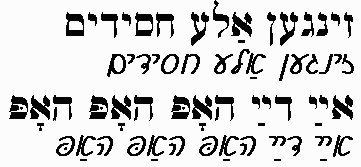

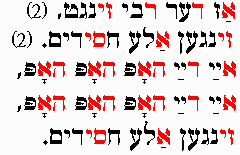
Let's continue with the song from lesson 1:


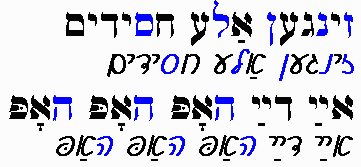
(Singing all the Khasidim
Ay Dy Hop Hop Hop)

Click on the transliteration of the words below to hear them and repeat after me:

ZIngen Ale khSIdim.
Ay Dy HOp HOp HOp


 click on each colored letter to hear its sound and learn more about it:


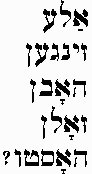
Click the Yiddish words to hear their sound
(M)-Masculine, (F)-Feminine, (PL)-Plural, (S)-Singular
Means... Pronounced...  The word 
allA'leh Click to listen to group 
to singZEEngen
to have HObn
shouldZOln
 have you? HOStu?
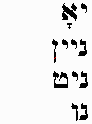
yes YO Click to listen to group 
noNEyn
notNIt/NIsht
 well, come on NU
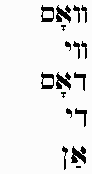
whatVOs Click to listen to group 
howVEE
the (n), (2) DOs
the (f),(Pl.), (2)DEE
 an  (3) A'n
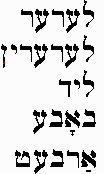
teacher  (m) LErer Click to listen to group 
teacher  (f) LErern
song  (m)  LEEd
grandmotherBObe
 work (f) A'rbet

Notes:
  1. The infinitive form of Yiddish verbs always ends in (Langer Nun).
  2. Most nouns are preceded by a definite article (m),   (f and pl), and
    for a neuter noun.
  3. Indefinite article before a vowel.


Click to check your progress by looking at the Yiddish Alphabet.
Click to watch the Alphabet scroll and identify the position of the letters you have learned in it.



Directions:

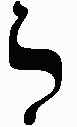
Write the letters in script:

        and


  Print these notes and the vowel table below and keep them handy for quick reference.


 1.The vowel "Yud" may also be a consonant like the letter "Y" in "yellow". It may also sound like a long "E" as in "baby", or a short "I" as in "in".    
 2.The Diphthong Tzvey Yudn sounds like "ey" in Grey.    
Note:
At the beginning of a word both the vowel
and the Diphthong are preceded by a silent .


Click on the Yiddish vowels to hear their sound:
In...Sounds like...The vowel...
baby  or  inE/I
GreyEy


The Hasid, Hasidism and Yiddishkeit:

The word derives from Hebrew, meaning "pious one". It is a pietistic movement within Judaism that began in the 18th century in southeastern Poland (Volhynia and Podolia) and continues to exist today especially in the United States and Israel.

      Click on:

to learn more about Hasidism and its links to the Yiddish language and Culture.


These self activities will help you exercise the material you learned in the classroom.

For questions about the course material please email Mindelle Wajsman

For questions regarding these self activities, please email Center for Yiddish Culture


Identify the vowel:
Choose a sound option from the drop down choices on the left and identify the related vowel by typing its number in the textbox:

Click to check your answers:

Multiple choice Quiz on pronunciation
Practice the Yiddish letters and words you learned:
Identify and check the correct transliterated sound.
Press "Reset" to begin.
View your score below.

Sounds:The
letter/word:
#
  An
  En
  In
6
  Va
  Vo
  Vi
7
  Vos
  Vas
  Ves
8
  Das
  Dos
  Des
9
  Ala
  Alu
  Ale
10
  
Sounds:The
letter/word:
#
  Neyn
  Nayn
  Niyn
1
  Zaln
  Zeln
  Zoln
2
  Hobn
  Hoben
  Haben
3
  Zingan
  Zingen
  Zingin
4
  Hastu
  Haste
  Hostu
5


Your Quiz Score is:


Multiple choice Quiz:
Identify and check the correct definite article.
Press "Reset" to begin.
View your score below.

Word:#
4
5
6
  
Word:#
1
2
3


Your Quiz Score is:


Identify the letters:
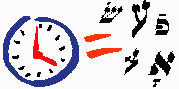
Play a timing game with the Yiddish letters.
Click the picture below to begin.
Good Luck


  Click the picture to listen
  Slide your mouse over a line to see its transliteration.
  Colored letters represent intonation.


Last lessonLessonsTop of the pageNext lesson

Lesson | Activities
E-mail

Return to Center for Yiddish Culture


All audio including songs provided by Yiddish instructor Ray Berman.
© Copyright 1993-2000
Dora Teitelboim Center for Yiddish Culture, Inc.
Instructional Design and Website Development by DaaT.
All Rights Reserved.